


One of the clearest signs that esports betting has moved into serious iGaming news is that the monitoring picture no longer lines up with the alarmist headlines. Available 2025 integrity data says roughly 100,000 esports matches were monitored and 34 were flagged as suspicious, about 0.03%, while football and basketball sat higher at 0.31% and 0.29% respectively (integrity analysis). That does not mean esports is risk-free, but it does mean the debate should start with where the risk sits and how it is measured, not with the loudest headline.
The market side tells a similar story. A peer-reviewed study estimated the global esports betting value at about $5 billion in 2016 and more than $12 billion by 2020, alongside a widely cited estimate of 495 million global esports viewers in 2020 (peer-reviewed market study). Those figures explain why operators, regulators, and suppliers can't treat this as a fringe vertical any longer, but they also need context. Market value estimates, audience counts, and operator revenue are not the same thing, and mixing them together leads to sloppy decision-making.
Table of Contents
- Why Esports Betting Now Warrants Serious Newsroom Coverage
- What Esports Betting Actually Means as a Product
- The Regulatory Frame Around Esports Wagering
- How Spectatorship Shapes Esports Betting Demand
- Integrity Risk in Esports Versus Traditional Sports
- How a Credible Esports Integrity Investigation Works
- Responsible Gambling and the Esports Audience Profile
- What Operators and Compliance Teams Should Watch Next
Why Esports Betting Now Warrants Serious Newsroom Coverage
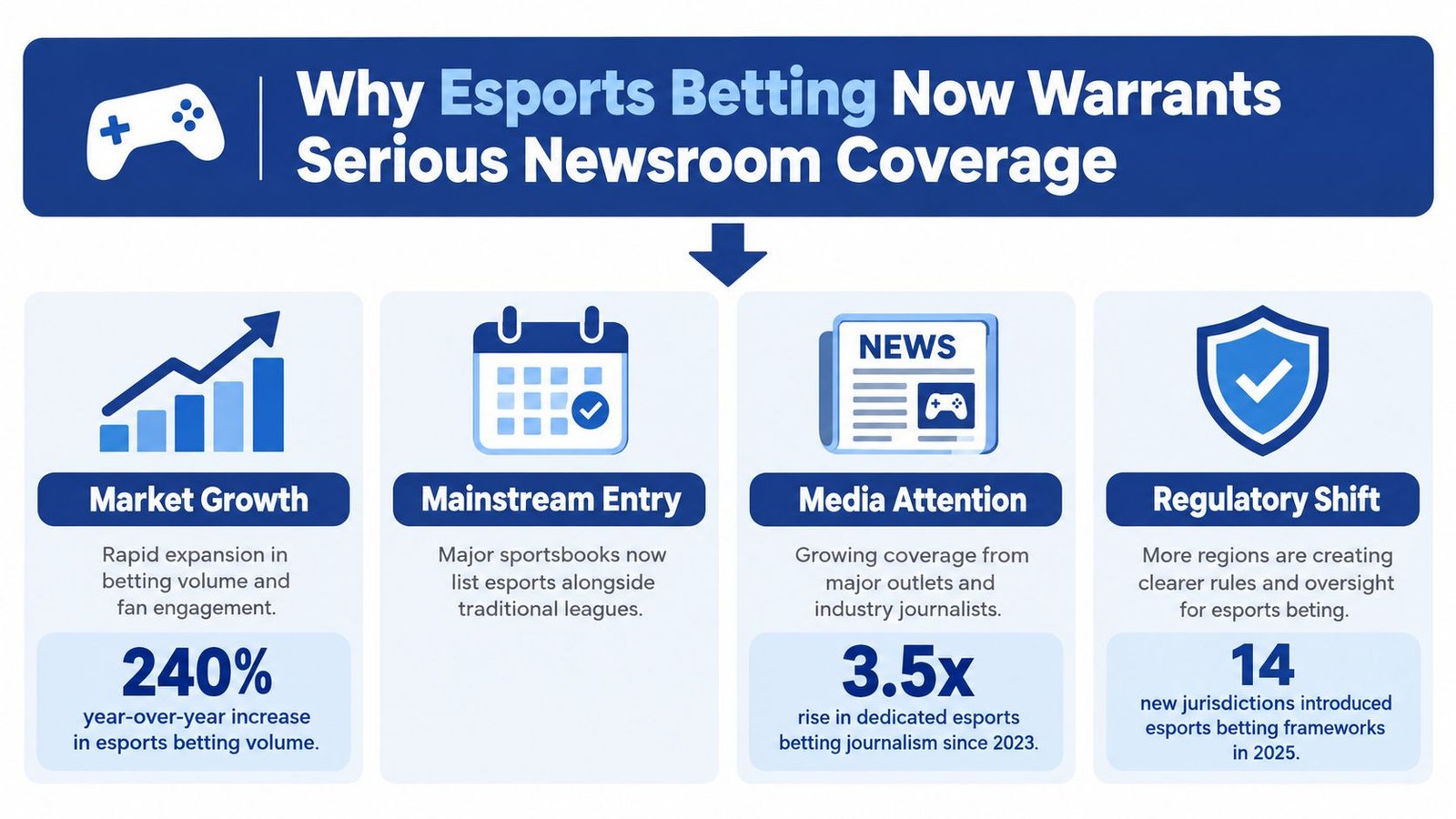
Esports betting belongs in mainstream esports betting news because the subject now sits at the intersection of audience reach, compliance, and trading discipline. A peer-reviewed market study found that the category has grown into a meaningful betting segment, while the audience footprint is large enough to justify close scrutiny of licensing, integrity controls, and consumer protection, not just headline market size (peer-reviewed market study).
Audience scale changed the editorial standard
A large viewer base with betting attached creates three separate reporting questions. How big is the audience, how is the product licensed, and how clean is the event data behind the price?
That is why clean coverage starts by separating audience scale, market value, and operator economics. A viewer estimate shows cultural reach, not handle. A market-value estimate helps explain direction, but it does not tell readers what a sportsbook booked, or whether margins improved.
A newsroom that treats every big number as equivalent will blur the story. A 495 million viewer figure is an audience estimate. Handle and revenue still need separate verification before anyone draws an operator-level conclusion.
The distinction matters because esports betting news often bundles different products into one phrase. Traditional event wagering, offshore markets, skin-related gambling, and other game-linked products are not the same activity, and mixing them makes regulatory reporting less useful. Editors who keep those lines clear can tell operators what is changing and what is noise.
For broader iGaming context, recent casino news coverage shows the same reporting problem, headline numbers often travel faster than the method behind them.
What Esports Betting Actually Means as a Product
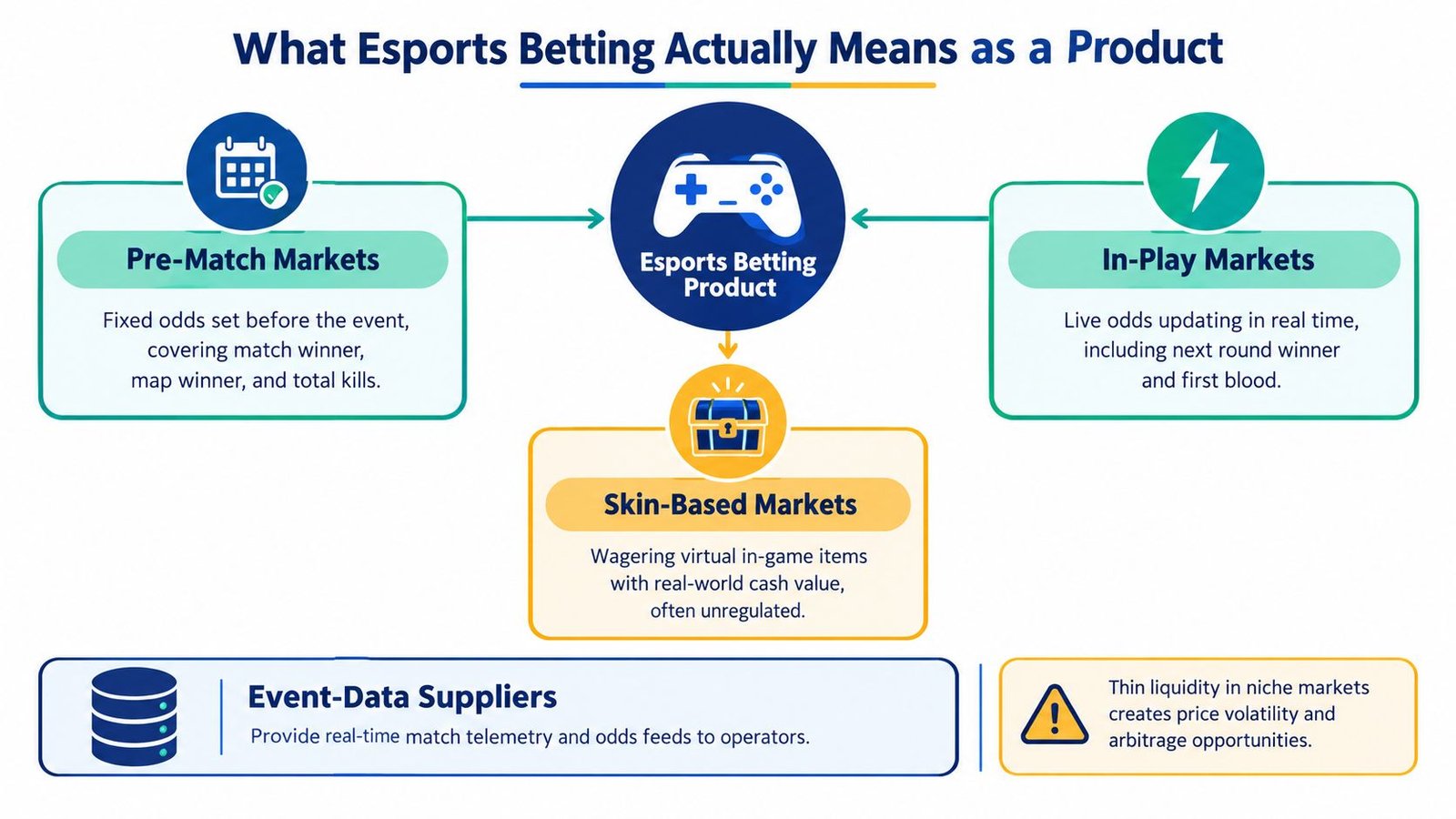
At product level, esports betting is not one thing. A sportsbook can offer pre-match markets, where prices are set before the first round or map begins, or in-play markets, where odds move as the game unfolds. Some parts of the ecosystem also include skin-based wagering, which sits much closer to game-item gambling than to standard sportsbook betting and often raises a different regulatory question altogether.
The product depends on live data, not guesswork
A serious esports trading desk needs event data that is fast enough to keep pace with the match. That means scores, round states, map transitions, roster changes, and other match telemetry must arrive quickly enough for odds to stay usable. In a top-tier football fixture, a bookmaker can often lean on deep liquidity and long-established pricing models. In a niche esports market, thin liquidity can move prices sharply on relatively small stakes, which is why the same odds swing can look dramatic even when the underlying market is small.
That volatility has real business consequences. Traders need tighter controls around market depth, latency, and settlement, because a badly timed feed or a shallow market can create pricing gaps, expose arbitrage, or produce avoidable disputes. A product team building around CS2 or League of Legends also has to think about event structure, map count, and whether the data source is reliable enough for live betting.
Thin esports markets can look more chaotic than they are. A fast-moving price does not automatically mean suspicious behaviour, it can also mean the market is shallow.
The cleanest way to think about the product is this, esports betting is a data-dependent wager on a digital competition, and the data chain matters as much as the bet slip. If the feed is weak, the market is weak. If the market is weak, integrity monitoring, settlement, and customer communication all get harder.
The Regulatory Frame Around Esports Wagering
In Great Britain, esports betting sits inside the same licensing logic that applies to betting on other live events, not outside the system as a separate gaming product (UK Gambling Commission guidance). That matters because it forces operators to treat esports as a regulated betting activity with the same baseline obligations around licensing, age checks, advertising controls, and monitoring.
Nevada makes the due-diligence burden even more explicit. Before accepting wagers on an esports event without separate approval, sportsbooks must document the video game and publisher, the event operator, the operator's authorization or affiliation, the event rules, and the technology used to determine the result (Nevada esports framework). The framework also requires records to be retained and updated, with quarterly reporting of event operators used during the previous quarter.
What regulators want to see before markets go live
| Required Input | Purpose | Cadence |
|---|---|---|
| Video game and publisher | Confirms the title and rights holder behind the event | Before wagers are accepted, then updated if needed |
| Event operator | Identifies who runs the competition | Before wagers are accepted, then reported quarterly |
| Authorization or affiliation | Shows the operator is legitimately connected to the publisher | Before wagers are accepted, then kept on file |
| Event rules | Defines how outcomes are determined and disputes are resolved | Before wagers are accepted, then updated if changed |
| Result-determination technology | Confirms the process used to produce a verifiable outcome | Before wagers are accepted, then retained in records |
That table is more than paperwork. It shows that mature jurisdictions want event validation before exposure, not after a complaint. For operators, this shifts esports from a marketing question to a diligence question. For compliance teams, it means supplier contracts, tournament approvals, and settlement controls all become part of product approval, not just back-office administration.
The practical mindset here is conservative. If an event cannot be supervised, verified, and documented, it should not be treated like a normal betting market. That's especially relevant for smaller competitions where rights chains are messy and results may depend on tools or processes that need extra scrutiny. Readers tracking local compliance developments can compare that approach with the broader licensing tone seen in Philippine casino and regulatory coverage.
How Spectatorship Shapes Esports Betting Demand
The strongest behavioural clue in the literature is that watching esports and betting on esports tend to travel together. A systematic review found six studies reporting a positive link between esports spectatorship and betting, three identifying viewing frequency as a statistically significant predictor, and one cited figure showing 90% of esports bettors had previously watched an esports event (systematic review).
That changes how news coverage should read. Livestream integrations, influencer promos, co-streaming, and tournament broadcasts are not only distribution channels. They are also the main contact surface where betting intent forms. In other words, the betting story often starts long before a sportsbook app opens.
Why the media layer matters to operators
A betting offer attached to a live broadcast can move faster than a traditional sports campaign because the audience is already immersed in the event. That makes conversion easier, but it also creates a tighter overlap between entertainment and gambling exposure. The same viewer who is legally eligible to bet may also be younger, digitally native, and highly responsive to creators or chat-driven promotions.
That's why operators can't treat esports as a simple copy of a football product. The media environment is different, the social layer is stronger, and the promotional path into betting is often shorter. It also explains why responsible-gambling teams need to work with marketing, partnership, and stream-integrations teams rather than reacting after launch.
A sportsbook that understands the viewing journey can design a safer funnel than one that only understands the bet slip.
The key editorial point is not that spectatorship causes gambling, because the evidence doesn't prove that. The point is that the relationship is consistent enough to matter for commercial planning and regulatory scrutiny. Anyone reading esports betting news through that lens will understand why livestream rights, creator partnerships, and broadcast access keep showing up in compliance conversations.
Integrity Risk in Esports Versus Traditional Sports
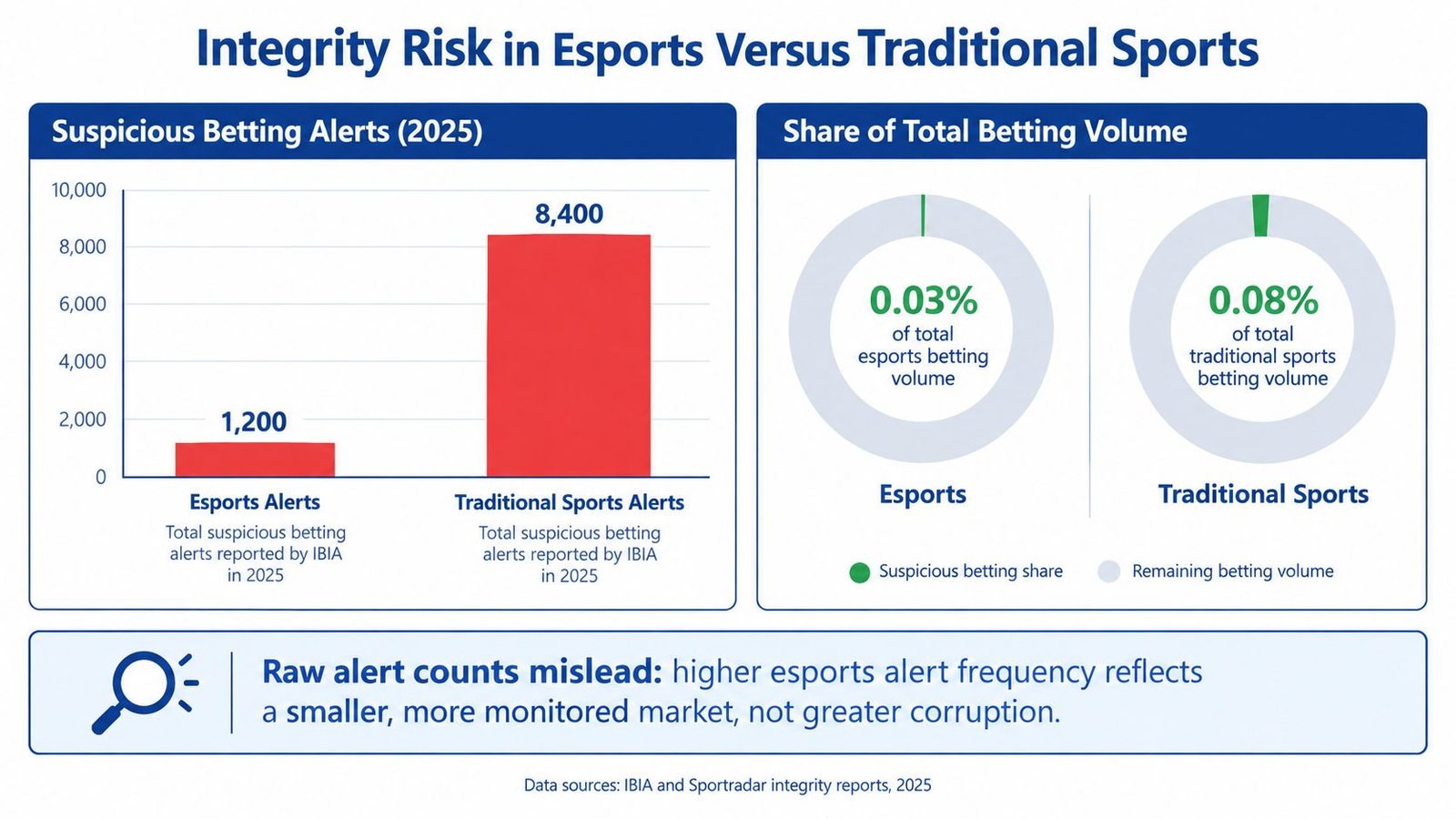
The 2025 monitoring picture does not support the assumption that esports is more corrupt because it is digital. Analysts tracking integrity signals reported roughly 100,000 esports matches, 34 suspicious flags, and a suspicious rate near 0.03%, compared with 0.31% for football and 0.29% for basketball (2025 integrity analysis).
Those figures do not prove the sector is clean. They do show that risk is concentrated rather than spread evenly across the category. The same analysis points to nine sanctions in 2025 and identifies lower-tier events as a persistent pressure point. It also records 34 IBIA suspicious-betting reports linked to esports, which places the category inside the wider integrity-monitoring framework rather than outside it.
Where integrity risk concentrates
Integrity pressure is heaviest in thinner, less visible competitions where liquidity is shallow and oversight is weaker. Small stakes can move those markets more sharply, traders have less context, and suspicious activity is harder to separate from routine noise.
The same pattern of under-regulated betting verticals migrating online is visible in online sabong coverage, where oversight gaps shaped the regulatory response.
Raw report counts can also mislead. More alerts do not automatically mean more corruption, especially in a smaller market with more active monitoring. The useful question is whether an alert leads to an investigation, whether the evidence holds up, and whether a breach is confirmed.
The UK Gambling Commission's integrity snapshot adds another reference point. It said esports accounted for 20% of the betting-integrity reports in its dataset, which shows why specialized reporting channels matter even when the underlying incidence rate is not clearly higher than in other sports (UKGC integrity snapshot).
How a Credible Esports Integrity Investigation Works
A credible integrity case starts with separate evidence streams, not a single suspicious market move. Riot Games' review of the 2025 VALORANT Challengers North America allegations combined tournament-platform data, live-account reviews, user-behaviour logs, in-game data, and betting-market analysis from Sportradar, GRID, and IBIA, then concluded that no games were flagged as suspicious (Riot Games review).
That workflow is the right template because it forces investigators to test the same allegation across multiple data layers. If one layer signals a problem and the others do not, the result may be a false positive, a market quirk, or a reporting error rather than misconduct.
The evidence chain that matters
- Tournament-platform data anchors the official schedule, rosters, and results.
- Account-level reviews show betting history, stake patterns, and identity checks.
- User-behaviour logs reveal login times, device fingerprints, and other account signals.
- In-game telemetry shows timing, movement, communication, and match-state behaviour.
- Betting-market analysis tracks odds movement, liquidity spikes, and anomaly flags.
Operational rule: preserve immutable timestamps, bet snapshots, IP or device relationships where lawful, and game-state events before trying to explain the pattern.
That sequence matters because esports cases can unravel quickly if teams treat an alert as proof. A suspicious line move may reflect information flow, poor liquidity, technical latency, or a genuine integrity problem. Investigators need to triage false positives, correlate the data sets, and report the status accurately.
The reporting language also matters. Allegation, investigation, market alert, and confirmed breach are not interchangeable terms. Editors and compliance teams should keep them separate, or they risk overstating a story before the evidence is mature.
For readers checking account hygiene across related betting verticals, the same caution applies to phishing and account-security practices, because compromised accounts can distort both integrity reviews and customer disputes.
Responsible Gambling and the Esports Audience Profile
The audience is younger than a standard sportsbook crowd, but it is not primarily underage. A 2025 audience analysis found bettors aged 19 to 35 accounted for 69% of esports betting activity, with the 26 to 35 group alone at 42.8%. In the UK Gambling Commission-cited figure, 8.5% of adults had bet on esports (audience analysis).
That profile creates a specific compliance problem. The market is largely adult, yet it remains digitally native enough that promotions can reach younger viewers through livestreams, creators, and mobile-first betting journeys. Generic sportsbook safeguards often miss that nuance.
What a tighter responsible-gambling model looks like
- Age assurance at registration. Verification should happen early, not after deposit activity begins.
- Promotion controls for youth-skewed broadcasts. Marketing around streams and creator content needs tighter audience selection.
- Affordability and spending controls. Fast deposit flows should not bypass basic risk checks.
- Enhanced monitoring for esports-specific markets. In-play behaviour and frequent session patterns deserve closer review than a standard pre-match slip.
- Clear support prompts. Reality-check messages and self-exclusion tools need to be visible inside the product, not buried in footers.
The useful insight here is that the market's age profile cuts both ways. It weakens simplistic claims that esports betting is mainly an underage issue, but it also shows why the sector can't borrow sports-betting controls without adjustment. A compliance lead should ask where the audience is watching, how quickly the bet can be placed, and whether the promotion path is built around fans or around frictionless conversion.
The best safeguard is the one that matches the media habit behind the wager, not the one designed for a different sport.
What Operators and Compliance Teams Should Watch Next
Three signals will shape the next planning cycle. The first is whether more jurisdictions adopt Nevada-style approval and documentation requirements. The second is whether publishers, integrity firms, and sportsbooks standardize what gets shared when an alert is raised. The third is whether product controls are built around viewing habits rather than recycled sportsbook templates.
Operators tracking jurisdiction-by-jurisdiction adoption can follow the latest PAGCOR regulatory updates for 2026 as a live case study in licensing tone.
The reporting side matters just as much. As noted earlier, the UKGC snapshot showed how esports can appear in integrity monitoring without making the broader market look large, which is why the next useful benchmark is not a headline number but whether operators can compare alerts across events in a consistent way. Quarterly integrity reporting from bodies such as the IBIA is the cleaner reference point for that kind of comparison.
The practical watchlist is straightforward. Event-data quality determines whether an alert can be tested, licensing conditions determine what an operator can offer, integrity partnerships determine how fast evidence moves, and consumer-protection design determines whether the product can stand up to scrutiny. Those are the markers that separate a market that is being managed from one that is merely generating noise.
For operators and regulators, the issue is no longer whether esports betting will stay in the news. It will. The key test is whether the coverage reflects disciplined controls and usable evidence, or avoidable gaps in documentation, reporting, and market supervision.





Join thousands of gaming professionals receiving the latest iGaming news, regulatory updates, and market insights.
