


Online gambling news is no longer mainly about headline revenue. The more revealing signal is operational, digital engagement, where the United States logged $13.71 billion in nationwide sports-betting revenue in 2024 and $5.14 billion in combined online sports betting and iGaming revenue in Q3 alone, equal to 29.0% of total commercial gaming revenue for that quarter (American Gaming Association Q3 2024 commercial gaming report). In Great Britain, the market continues to show the same pattern, with online activity, product mix, and transaction volume increasingly defining how the sector is read by operators, regulators, and investors.
The strategic shift matters because market size alone no longer explains performance. Revenue growth is now tightly linked to how often customers return, how many bets they place, how product categories split, and how regulation changes play out in actual behavior. That's why online gambling news has become a blend of market intelligence, compliance analysis, and product-level diagnostics, not just earnings reporting. For readers tracking digital wagering ecosystems, the useful question is less “how big is the market?” and more “what is driving it, who is being affected, and what risks are being hidden inside the growth?”
Table of Contents
- The Scale of the Digital Shift in Global Gaming
- Decomposing Player Participation and Product Metrics
- The Hidden Friction Between Personalization and Privacy
- Evaluating the Actual Impact of Regulatory Interventions
- The Maturity Gap in Responsible Gambling Analytics
- Building Continuous Integrity and Surveillance Infrastructure
- Strategic Takeaways for iGaming Decision Makers
The Scale of the Digital Shift in Global Gaming
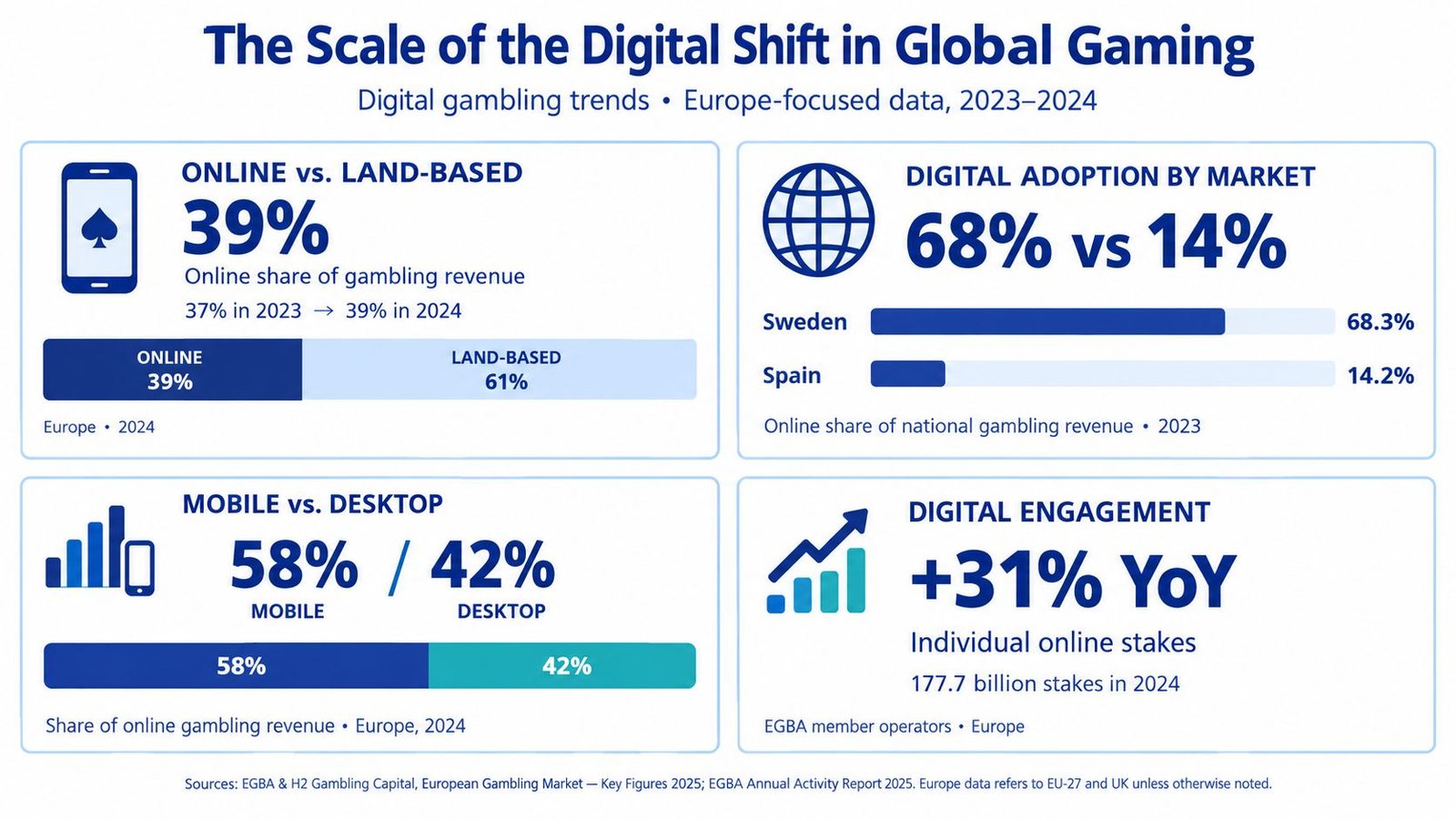
Recent market data shows that digital betting has become a core revenue engine. In the U.S., nationwide sports-betting revenue reached $13.71 billion in 2024, up 25.4% year over year, while combined online sports betting and iGaming revenue hit $5.14 billion in Q3 and represented 29.0% of total commercial gaming revenue for that quarter (AGA Q3 2024 report). That scale matters because it shows digital wagering is now built into the commercial model, not layered on top of it.
Great Britain points to the same shift through activity density. The Gambling Commission's April to June 2024 operator data recorded £1.46 billion in online GGY, with customers placing more than 24.5 billion online bets and spins, the highest quarterly total in the dataset (Gambling Commission operator data, April to June 2024). That volume matters because it captures engagement depth as well as monetization. Online slots and real-event betting both carried weight, which means product performance now depends on calendar effects, interface design, retention logic, and the friction created by payment checks and responsible gambling controls.
.](https://instaplayph.com/wp-content/uploads/2026/10/online-gambling-news-digital-shift.jpg)
Why the volume signal matters
Volume is the hidden part of the story. When bets and spins rise faster than customer counts, operators are pulling more activity from active accounts rather than depending only on new acquisition. That changes how analysts should read growth, because it usually reflects stronger engagement loops, tighter product fit, or heavier promotional pressure. It also raises the stakes for payment reliability, affordability checks, and player safeguards.
A mobile-first access path can sharpen that reading further. For a concrete view of how that channel mix looks in practice, see the GCash casino access guide, which helps frame the experience around wallet-based entry and casino use.
Revenue growth in online gambling news should always be read alongside transaction density. A rising GGY line with weak engagement data tells only part of the story.
The U.K. data also explains why investors and suppliers need more granular intelligence than a simple market-size headline. A quarter with record online bets and spins can still contain very different signals across sports, slots, and active-account trends. That mix shapes commercial durability, especially when major tournaments or product-rule changes alter play patterns.
Decomposing Player Participation and Product Metrics
Headline participation figures can obscure the actual market mix if analysts do not separate lottery-led activity from higher-value wagering. A 2025 Gambling Commission survey found that 38% of adults had participated in online gambling in the previous four weeks, but that figure fell to 17% when people who only bought lottery-draw tickets online were excluded (Gambling Commission participation survey, April to July 2025). That gap matters because it changes how market size, acquisition efficiency, and responsible gambling exposure should be read.
Product mix changes the market picture
The same survey showed that the most common online activities were National Lottery draw tickets at 25%, charity lottery tickets at 15%, and online or app-based sports and racing bets at 10%. That ordering matters because lottery participation dominates the broad participation measure, while sportsbook and casino activity shape the commercial cadence of the sector.
A useful reading of online gambling news separates broad participation, commercial engagement, and regulatory exposure. Those layers rarely move together. A market can look large in a survey and still be concentrated in a narrower set of products with different risk, retention, and margin profiles.
| Activity Type | Participation Rate |
|---|---|
| National Lottery draw tickets | 25% |
| Other charity lottery tickets | 15% |
| Online or app-based sports and racing bets | 10% |
| All online gambling, including lottery-draw tickets | 38% |
| Online gambling excluding lottery-draw tickets only | 17% |
That distinction also changes how acquisition teams should think about growth. Better segmentation beats broader assumptions, and knowing your user acquisition cost is the baseline metric for that work. If lottery-heavy participation is read as equivalent to active wagering demand, budget decisions can tilt toward the wrong channels and the wrong product mix.
The same survey also showed why product-level analysis is useful for policy and commercial planning. A quarter with strong online participation can still conceal very different signals across lotteries, sports, and active-account behavior. For investors and operators, that means the headline number is only the starting point. The key question is which products are driving repeat activity, which are padding the top line, and which are shaping the market's underlying durability.
The most expensive analytical mistake in online gambling is treating a participation headline as if it described the whole product economy.
For investors, the lesson is to avoid valuing the market by lottery-heavy participation alone. For policy teams, the same split shows why product-level decomposition is needed before any claim about expansion or harm prevalence is made.
The Hidden Friction Between Personalization and Privacy
A commercial stack that sends personal data before consent is not just a compliance problem. It also changes how operators weigh acquisition, retention, and responsible gambling controls. A 2026 Swansea University audit of 624 U.K.-licensed online gambling websites found that 86% appeared to breach GDPR requirements, while 67% transmitted personally identifiable information to third-party analytics or marketing platforms before users gave consent (Swansea University audit). That is a clear sign that commercial data flows are often moving faster than consent management.

VIP logic and risk markers overlap
The same audit found that the data used to identify commercially valuable customers overlapped substantially with behavioral markers associated with gambling harm. That overlap matters because it weakens the idea that VIP, retention, and personalized-offer systems are purely commercial. In practice, the same segmentation logic can flag high-value players and high-risk players in the same workflow.
If a platform uses loss frequency, chasing patterns, or response to incentives to shape outreach, the boundary between personalization and harm management becomes hard to defend. Operators may not intend to intensify risk, but intent does not solve for governance when pre-consent data sharing is already taking place. Pre-consent data sharing also widens the attack surface for players, as covered in this guide to avoiding phishing scams.
Operational takeaway: If a marketing stack can't explain where consent begins, it probably can't explain where risk profiling ends.
The practical response is stronger control, not less personalization. Consent flow design, third-party data sharing, retention rules, and segmentation logic should be reviewed as one system. Privacy reviews also need to sit alongside responsible gambling oversight, because a platform that cannot account for pre-consent tracking cannot show clean evidence that its intervention models are benign.
For operators, that means privacy work cannot stay inside legal teams. Product, CRM, payments, and RG teams need shared visibility into how customer data is captured, enriched, and acted on. In online gambling news, privacy is not a side issue. It is part of the commercial risk model.
Evaluating the Actual Impact of Regulatory Interventions
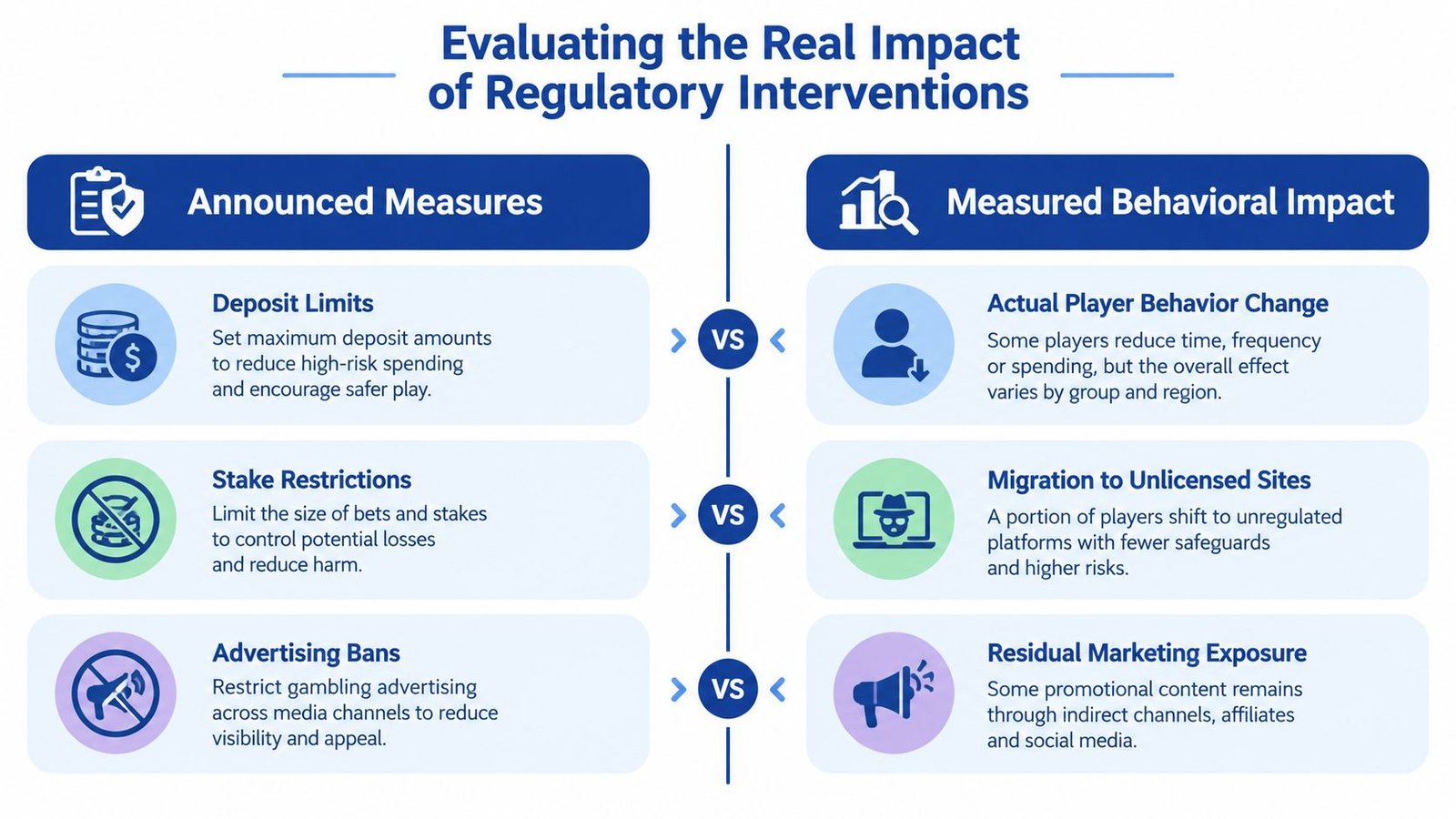
Stake limits and advertising rules are often presented as proof of progress at the moment they are announced. The useful test is whether player behavior changed, and whether that change persisted. Great Britain's differentiated maximum online-slots stakes in 2025 offer a useful post-implementation check, because subsequent data showed slots sessions lasting more than one hour fell 16%, average session length dropped by two minutes, and overall slots GGY still rose 10% year on year (Gambling Commission market impact data, December 2025).
What the post-implementation data can and can't prove
The data points to a cooling in extended-play behavior after the rule change. It does not establish that stake limits alone caused the shift. Product updates, seasonality, and changes in player mix can all affect session length, which is why policy reporting should avoid claiming causality where only correlation is visible.
A 2026 systematic review of international online-gambling policy evaluations found that commonly promoted responsible-gambling interventions have limited or no demonstrated behavioral impact, while legalization generally increases participation and harm and has limited success in eliminating illegal gambling (CityU global review of online gambling policy assessments). That finding argues for measurable post-policy metrics rather than rhetorical claims.
The right scorecard is narrow and operational. It should focus on deposit patterns, session duration, self-exclusion completion, and migration to unlicensed play where that can be observed. Without those measures, responsible-gambling policy can become compliance theater, with little evidence that customer behavior improved.
PAGCOR regulatory updates for 2026 are a reminder that jurisdiction-specific rules can move faster than the evidence base used to assess them. Evaluation design belongs inside the regulatory conversation, not outside it.
Regulators create the rules, but operators still have to prove whether the rules changed behavior in ways that matter.
For boards and compliance teams, the strategic implication is direct. Announcements are not outcomes. Post-implementation evidence is the only credible way to judge whether a control reduced harm, displaced activity, or merely pushed the same behavior into a different format.
The Maturity Gap in Responsible Gambling Analytics
Machine learning has become a standard part of responsible-gambling marketing language, but the evidence base is still thin. A peer-reviewed scoping review of 37 data-science studies found major limitations in generalizability and reproducibility, and concluded that practical adoption remains largely unexplored, with high-performing models in one context not safely assumed to transfer to another (Responsible gambling analytics scoping review). That is a serious constraint for an industry eager to automate risk detection.
Technical promise versus operational reality
The strongest models may still fail when the player base shifts, the product changes, or the jurisdiction's rules differ. A sportsbook with one promotional cadence can produce behavioral patterns that look unlike those of an online casino, even before regional differences in regulation are added. This is why out-of-sample validation, drift monitoring, and calibration testing aren't nice-to-haves. They're the minimum bar for any system meant to trigger intervention.
False positives are the other problem. Promotional spikes, major sporting events, and shared devices can all resemble risky play if the model is too rigid. When systems are used for affordability checks, account restrictions, or enhanced monitoring, the cost of overreach is not abstract. It lands on customer trust, regulatory defensibility, and complaint volume.
A usable governance model should include:
- Out-of-sample validation to test whether the model performs outside the training environment.
- Drift monitoring to detect when player behavior or market structure changes.
- Explainable triggers so interventions can be reviewed and defended.
- Human review for consequential actions, especially restrictions and affordability escalations.
The strategic error is assuming that predictive accuracy equals readiness. In reality, the most valuable model is the one that survives audit, respects consent, and can be shown not to create avoidable customer harm. That standard is higher than vendor demos usually admit, but it is the one regulators and internal risk teams will increasingly expect.
Building Continuous Integrity and Surveillance Infrastructure
Sports-betting integrity is becoming a continuous operational function, not a periodic investigation. The U.K. Gambling Commission's Sports Betting Intelligence Unit recorded 587 unusual or suspicious betting reports in the April 2025 to March 2026 period, up from 501 the previous year (Gambling Commission integrity reports). That increase doesn't prove manipulation rose at the same pace, but it does show that the surveillance load is expanding.
What continuous surveillance needs
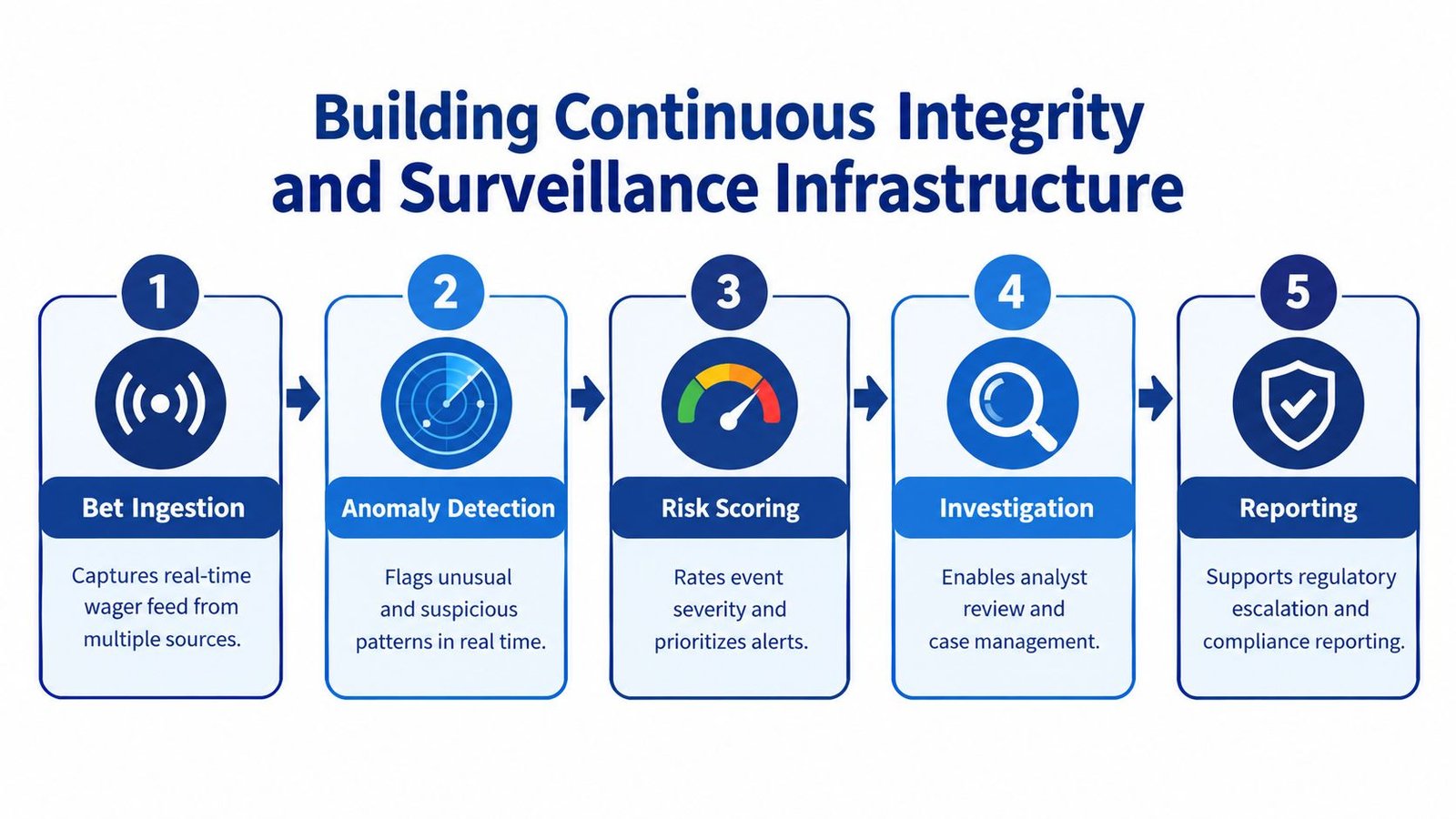
A workable integrity stack has to do more than collect alerts. It has to normalize different data sources, preserve event-level evidence, and route cases fast enough for operators, suppliers, and regulators to act on them. That makes betting integrity a data engineering problem as much as a compliance problem.
The priorities are straightforward:
- Bet ingestion: Capture real-time wager feeds before data is lost or transformed.
- Anomaly detection: Flag patterns linked to stake timing, account relationships, odds movement, geolocation, and bet-type concentration.
- Risk scoring: Separate explainable market behavior from events that deserve escalation.
- Investigation: Preserve audit trails so analysts can reconstruct what happened.
- Reporting: Package cases for regulator referral in a format that is easy to verify.
Integrity controls also need to coexist with privacy compliance. Data minimization matters, but so does evidentiary completeness when a suspicious pattern has to be reviewed. That means governance teams should define in advance which data fields are essential for risk detection, which can be retained, and how long the evidence trail should remain available.
PGCOR gaming system administrator requirements sit in the same strategic lane, because technical administration standards shape how quickly a market can respond to suspicious activity. The bigger lesson is that integrity can't be treated as a reactive cost center. It is part of the trust architecture that keeps regulated sports betting credible.
The stronger the digital market becomes, the more integrity depends on systems that see across operators, products, and event types instead of waiting for a single red flag.
Strategic Takeaways for iGaming Decision Makers
The current shape of online gambling news points to one conclusion. The industry is moving from growth measured in revenue alone to growth measured in data discipline, behavioral evidence, and auditability. That shift affects operators, suppliers, regulators, investors, and affiliates in different ways, but the strategic direction is the same.
What decision makers should prioritize
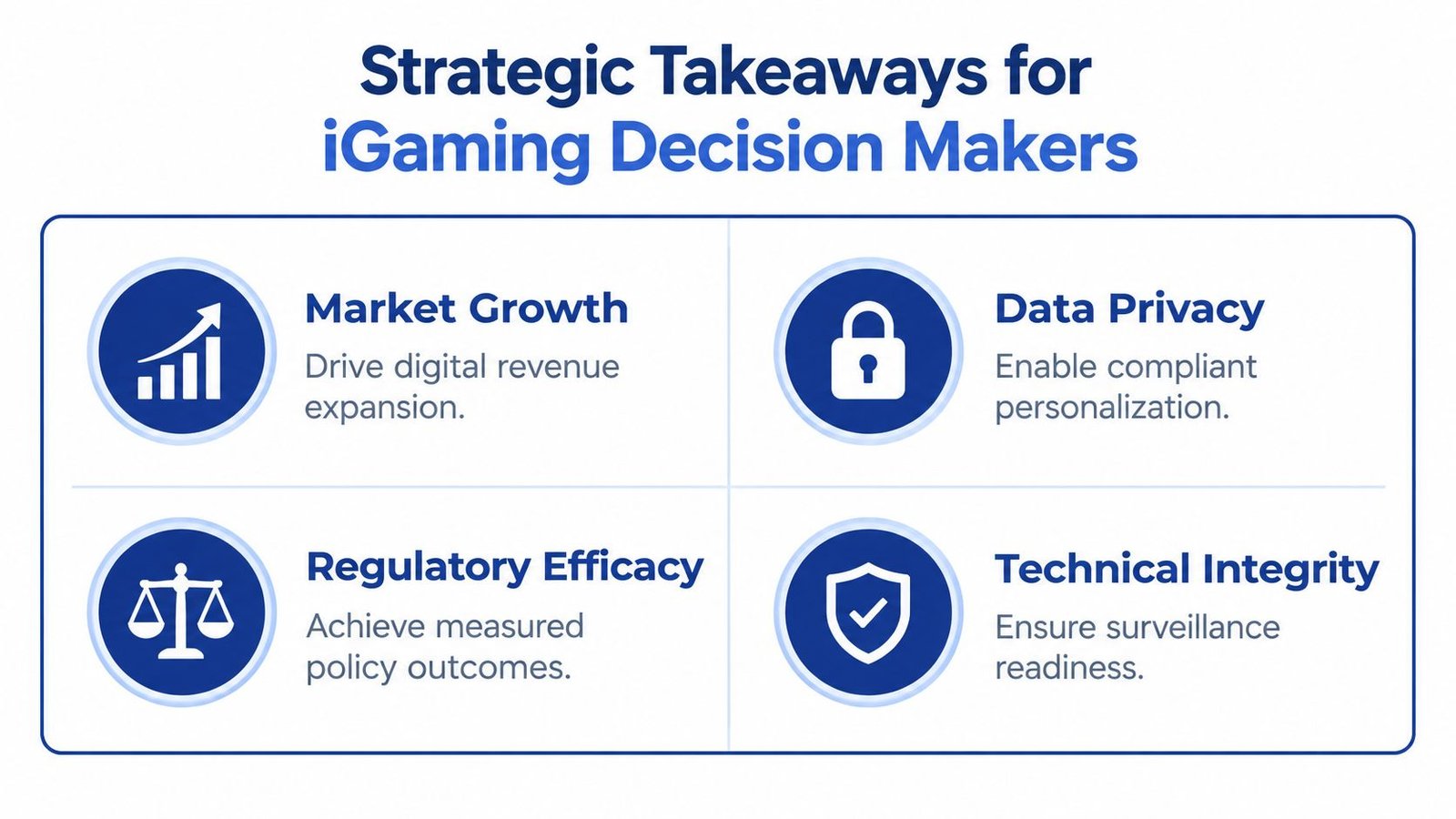
Market growth should be read through engagement depth, not just top-line revenue. Digital wagering is increasingly defined by transaction density, product mix, and event-driven spikes, so performance dashboards need to separate acquisition from active use.
Data privacy can't stay separate from personalization. If customer data is flowing to third parties before consent, the commercial stack is already creating compliance and reputational risk. That issue belongs in the same room as CRM and RG strategy.
Regulatory efficacy has to be proven, not announced. Stake limits, deposit controls, and advertising restrictions should be judged against observable behavior, including session length, migration, and persistence of risky patterns.
Technical integrity now requires continuous surveillance. Suspicious betting reports, anomaly detection, and case management are becoming core infrastructure, not exceptional workflows.
The decision framework is simple. Operators that treat privacy, risk detection, and integrity as separate workstreams will keep discovering conflicts late. Those that build a single accountability model will move faster and defend decisions more easily. Investors should reward the latter, because it has a better chance of surviving scrutiny when growth slows or the regulatory bar rises.
Top 1 Rank covers these shifts in global iGaming intelligence, so readers can track not just what changed, but what it means for compliance, commercial performance, and long-term market structure.





Join thousands of gaming professionals receiving the latest iGaming news, regulatory updates, and market insights.
