

Online casino regulation doesn't automatically make consumers safer. Great Britain's point-of-consumption framework covers remote gambling through a national regulator, while the United States had authorized online casinos in only six states by the end of 2022, despite 27 states having land-based commercial casinos.
That contrast exposes the central problem in modern gambling policy. A licence can create identity checks, responsible-gambling duties and enforcement powers, but it doesn't guarantee that customers will remain inside the licensed market. If regulated products become difficult to access, slow to onboard or commercially uncompetitive, offshore operators may continue to attract demand. The effectiveness of online casino regulation therefore depends on market channeling, not licensing presence alone.
Table of Contents
- The Global Landscape of Online Casino Regulation
- Contrasting Regulatory Models: The UK and US approaches
- Player Registration As A Compliance Control Point
- Responsible Gambling Monitoring Systems And Intervention Logic
- The Licensing Effectiveness Paradox In Consumer Protection
- Extended Enforcement Chains Beyond Operator Licensing
- Compliance Best Practices For Operators And Affiliates
The Global Landscape of Online Casino Regulation
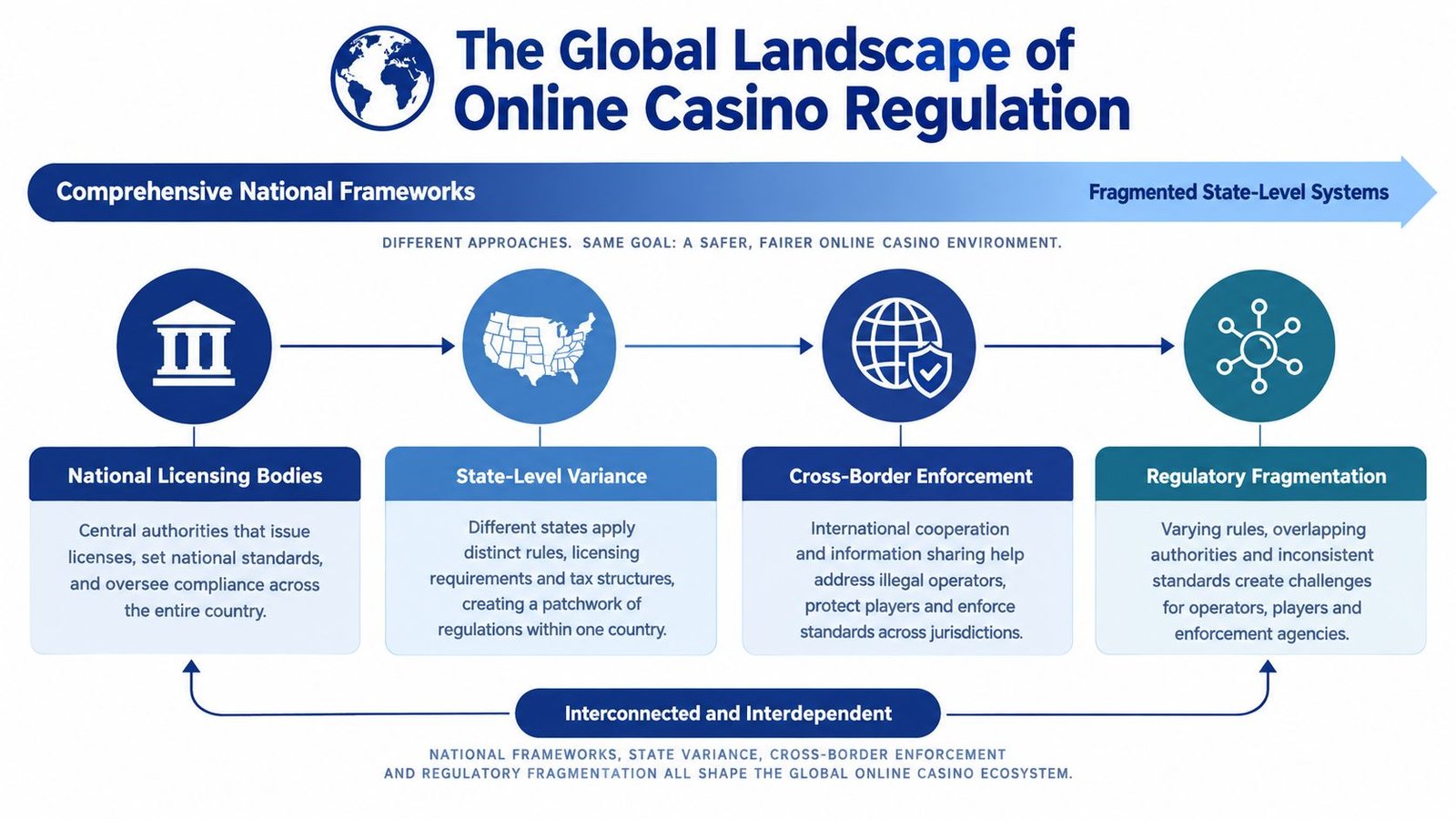
Online casino regulation is often described as a matter of licensing coverage. In practice, the harder question is whether a legal framework can keep consumers inside the supervised market instead of pushing them toward offshore sites. Jurisdictions differ not just in who issues licences, but in how they control payments, identity checks, technical certification, advertising, self-exclusion and enforcement evidence.
Great Britain is one example of a national, consumer-facing system. The Gambling Act 2005 created the Gambling Commission as the main regulator for casinos, betting, bingo, gaming machines, lotteries and remote gambling. It entered into force in September 2007, and the 2014 changes extended licensing duties to operators based outside Great Britain if they accepted British customers. That point-of-consumption logic matters because it ties compliance to where the player is, not where the company is incorporated.
The United States distributes that decision differently. Federal law sets outer limits, including payment restrictions under the Unlawful Internet Gambling Enforcement Act of 2006, but individual states decide whether online casino play is permitted. The result is not a stricter or looser model. It is a fragmented one, where licensing, geolocation, testing, tax treatment and player protections can vary materially across state lines.
Why one compliance model fails
A licence in one jurisdiction does not travel well. An operator expanding across borders may face centralized reporting in one market, but separate technical approvals, local partners or jurisdiction-specific controls in another. Those differences also affect suppliers, affiliates and payment providers, which can acquire regulatory exposure even without a direct contract with the player.
The Philippines shows why local authorization cannot be inferred from an overseas approval. For operators assessing Asia-Pacific entry, PAGCOR online casino requirements in the Philippines are a useful example of a market where the compliance question starts with domestic authorization, not with the existence of a foreign licence.
Cross-border enforcement is now becoming part of the model. Austria, France, Germany, Great Britain, Italy, Portugal and Spain agreed in November 2025 to share intelligence, coordinate complaints involving illegal advertising and exchange enforcement practice. The European regulatory cooperation report shows why licensing presence alone has limited effect when customer acquisition flows through social platforms, video services and affiliate networks outside a single regulator's reach.
Contrasting Regulatory Models: The UK and US approaches
A licence can define legal market access without proving that consumer protection works equally well in practice. The clearest contrast is between Great Britain's nationally applied model and the United States' state-led approach. Both regulate online gambling. They differ on where jurisdiction starts, who grants market entry, and how consistently rules can be applied across the customer base.
In Great Britain, the trigger is service to British consumers. The 2014 licensing expansion reduced the importance of where an operator is headquartered and tied market access more directly to British licensing, compliance controls, supervision, and enforcement. That structure gives the regulator a cleaner jurisdictional basis for remote gambling than systems that depend on the operator's place of incorporation.
The commercial context matters. Online gambling gross gambling yield, meaning stakes retained after winnings are paid, increased by 18% in real terms between 2015–16 and 2018–19, while the overall gambling market grew by 4% over the same period. In September 2019, remote gambling generated more gross gambling yield than land-based gambling for the first time, excluding lotteries. Those shifts help explain why remote regulation moved from a peripheral issue to the centre of British gambling oversight.
A national market versus a state patchwork
The US followed a different route. Instead of building online casino regulation through one national statute, it developed through separate state legalization decisions layered on top of federal constraints. Commercial casino expansion spread gradually across the states during the late 1980s, 1990s, 2000s, and 2010s, but online casino authorization remained much narrower.
By the end of 2022, 27 states had land-based commercial casinos, but only six states had authorized online casinos: Connecticut, Delaware, Michigan, New Jersey, Pennsylvania and West Virginia. The Congressional Research Service comparison of US gambling regulation shows the core point. Permission for casino gambling on the ground does not automatically extend to casino gambling online.
| Regulatory question | Great Britain | United States |
|---|---|---|
| Primary architecture | National framework | State-level authorization |
| Licensing trigger | Serving consumers in Great Britain | Satisfying each state's regime |
| Federal or national role | Gambling Commission under the Gambling Act 2005 | Federal payment and legal boundaries |
| Main operational challenge | Cross-border compliance under one consumer market | Different state rules and approvals |
| Market implication | Unified access standard | Fragmented market entry |
The practical result is not a simple choice between strict and loose regulation. Great Britain can impose a more uniform access standard across one consumer market. The US gives states more direct policy control, but operators must handle separate licensing, tax, geolocation, technical, suitability, and consumer-protection requirements.
That difference matters, but it should not be overstated. A single national framework can improve consistency without eliminating illegal supply. A fragmented state system can restrict legal scale without preventing players from crossing into unlicensed channels. The gap between licensing presence and protection effectiveness sits in enforcement reach, channel control, and whether regulated offers are competitive enough to keep play inside the legal market.
Player Registration As A Compliance Control Point
Registration is the first point at which an operator can connect a person, payment activity and gambling behavior into one accountable record. Treating it as a simple account-opening form weakens age assurance, fraud prevention and responsible-gambling intervention because later signals may not reliably belong to the same individual.
The European Commission recommends that every player hold a registered account, that identity be checked through electronic checks or official records, and that operators track player behavior. It also recommends making deposit and time limits available by default at registration. The European Commission's responsible-gambling recommendation links registration with the operator's ability to identify risk over time.
A staged onboarding architecture
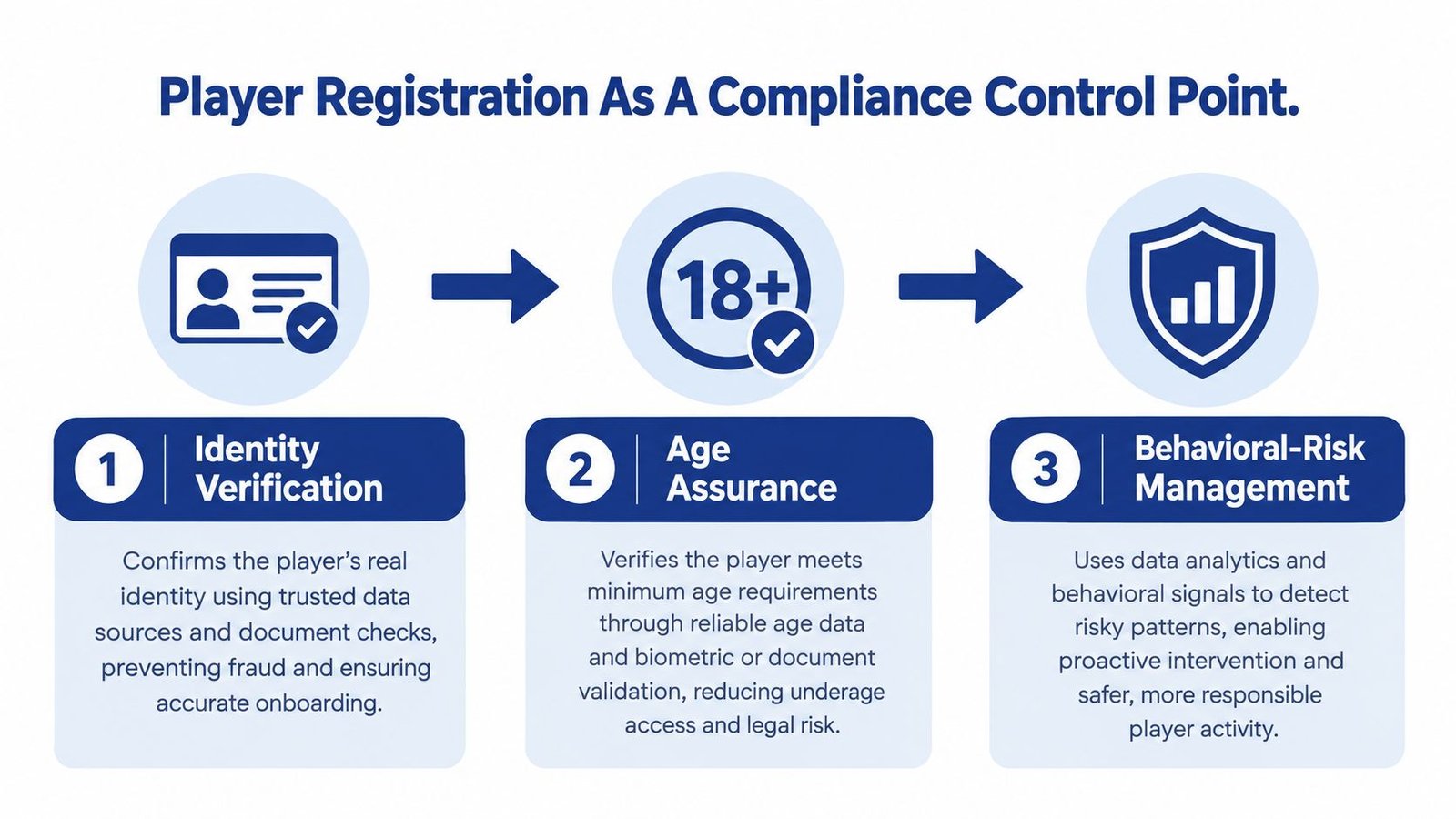
A defensible workflow separates the control objectives while keeping them connected:
Identity verification should collect and validate the customer's identity attributes through electronic checks or official records. The account identifier then becomes the reference point for deposits, withdrawals, gameplay and support contacts.
Age and jurisdiction screening should occur before gambling access. Registration data must establish whether the customer is eligible to use the service in the relevant jurisdiction, rather than leaving those checks until a withdrawal request or a later compliance review.
Behavioral-risk management should begin at account creation. Deposit limits and time controls need to be visible before the first deposit, because a control presented only after gambling activity has started arrives too late to serve as an initial safeguard.
Persistent attribution creates the longitudinal dataset needed to connect deposits, losses, session duration, limit changes, self-exclusion signals and payment activity. That connection helps identify duplicate or anonymous accounts and gives staff a fuller basis for intervention. It also creates privacy obligations. Purpose limitation, data minimization, retention controls, access restrictions and lawful processing must constrain the system.
For market participants assessing Philippine infrastructure, PAGCOR payment gateway accreditation shows why payment architecture cannot be separated from player identity and regulatory controls. A payment event is also a compliance event when it can be linked to a customer record and a gambling account.
Responsible Gambling Monitoring Systems And Intervention Logic
Intervention systems fail when they measure activity instead of effect. A safer model treats responsible-gambling monitoring as a decision cycle with accountability at each stage: detect risk, choose a response, record why that response was chosen, then assess whether customer behavior changed.
The UK framework makes that sequence explicit. Gambling Commission guidance points operators to signals such as customer spend, spending patterns, time spent gambling, gambling behavior, customer contact, use of management tools and account indicators. The Commission's GDPR and gambling regulation guidance also ties that monitoring to account-opening controls and recordkeeping obligations, including cases where intervention was delayed or did not occur.
That matters because a message, pop-up or limit reminder is only a logged action. It is not evidence that harm risk fell.
A workable system usually combines four connected functions. First, the operator captures events across deposits, withdrawals, losses, session duration, limit changes, support contacts and self-exclusion signals. Second, it turns those events into usable indicators, including rolling and cumulative views that distinguish a short spike from a longer deterioration pattern. Third, it routes cases through jurisdiction-specific rules, so some alerts lead to automated friction while others go to trained staff for review. Fourth, it preserves a case history that links trigger, decision, intervention, outcome and follow-up date in a form compliance teams can audit.
The last function is the one that separates visible compliance from effective consumer protection. Operators can show extensive intervention volumes and still miss the harder question: which actions changed conduct, which failed, and which should have been escalated sooner? In practice, the gap between licensing presence and protection quality begins to show. A jurisdiction may require monitoring, but weak feedback logic can leave customers exposed behind a fully licensed interface.
Operational test: An intervention is incomplete until the operator has evaluated its outcome and decided whether escalation or follow-up is necessary.
Useful performance review therefore goes beyond alert counts. It should examine detection latency, intervention rates by risk tier, repeat-risk escalation, customer response and the recorded rationale for non-intervention. Cross-session data improves assessment only when the operator uses it lawfully, consistently and in a way staff can act on.
The Licensing Effectiveness Paradox In Consumer Protection
Licensing presence and consumer protection effectiveness are related, but they are not the same outcome. A jurisdiction can impose tighter entry rules, stronger safer gambling controls and heavier supervision, yet still leave a meaningful share of demand outside the regulated system. The policy question is therefore narrower and harder. How much customer activity stays inside the licensed channel once the rules are in force?
Spain shows why that distinction matters. As noted earlier, the regulated market expanded sharply in 2024, with growth in active players, younger adult participation, monthly active accounts and €8.108 billion in gross gaming revenue. Those figures confirm scale and momentum. They do not, by themselves, show whether licensed safeguards drew players away from illegal supply or whether unlicensed alternatives remained commercially relevant.
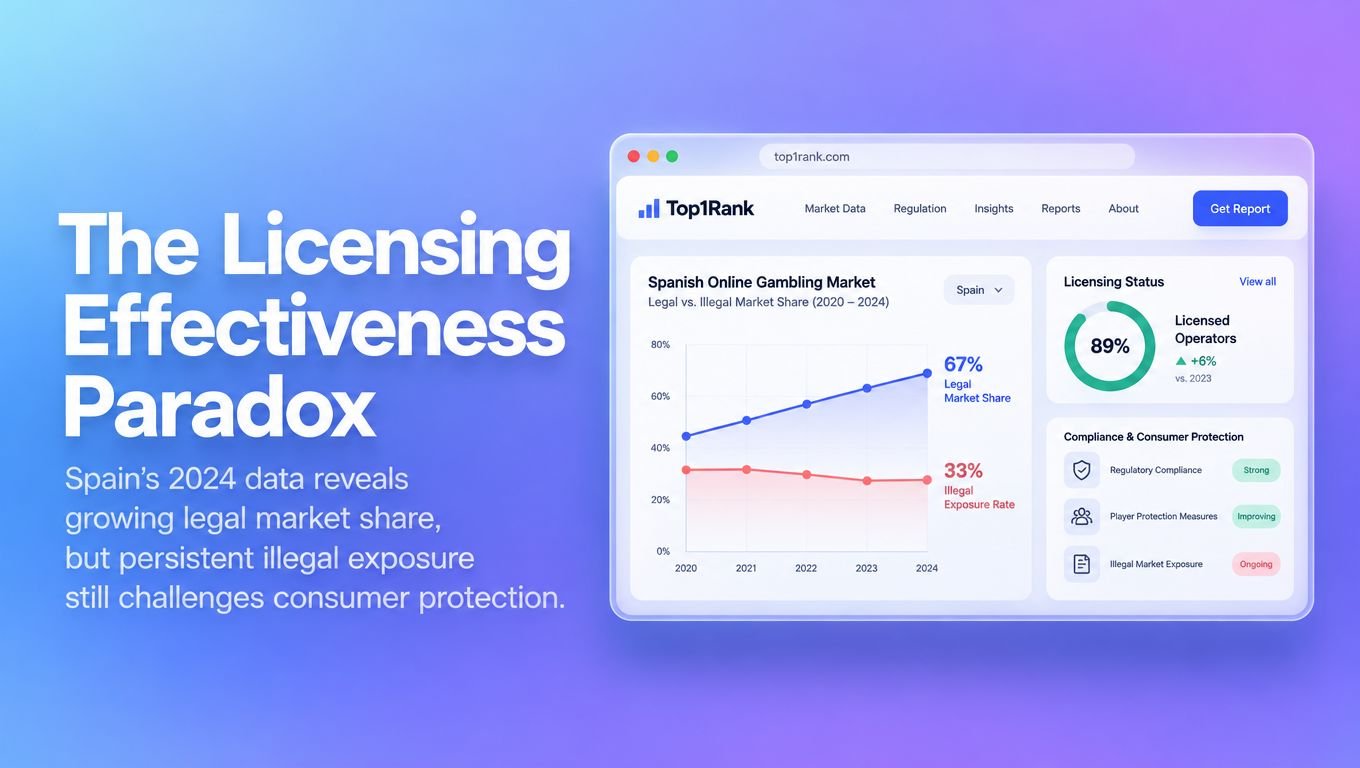
A useful assessment starts with channeling. Holding KYC, deposit limits and exclusion tools is the entry condition. The decisive metric is the share of customer activity that remains within the regulated environment after registration, payment and product restrictions are applied. If customers discover a licensed brand but complete their play elsewhere, formal compliance has not delivered the full protective effect regulators intended.
That is why the benchmark has to combine several signals at once: licensed participation through authorized brands, offshore discovery visible in search demand and referral patterns, payment friction that interrupts legal play, and customer migration visible in complaints, enforcement records or movement around exclusion barriers.
The tension is structural. Higher compliance burdens can improve documentation and intervention quality while also making licensed products slower to access or less attractive against illegal competitors. In that setting, stricter rules may improve protections for customers who stay inside the system, yet do less than expected to reduce illegal market participation overall.
A practical reading of local access conditions matters here. A market example involving Mega Panalo Casino shows why licensing context, payment access and user journey design have to be assessed together. Consumer protection depends on the full path from discovery to complaint resolution, not on licence status alone.
Extended Enforcement Chains Beyond Operator Licensing
The commercial path to an illegal casino rarely begins and ends with the operator. It can include an advertiser, affiliate, social platform, influencer, payment provider, software supplier, white-label platform and cloud infrastructure provider. Enforcement that targets only the licensed entity may miss the actors that create reach, process funds or maintain technical availability.
The seven-regulator agreement reached in November 2025 signals this broader approach. Austria, France, Germany, Great Britain, Italy, Portugal and Spain agreed to share intelligence, coordinate complaints against illegal advertising and exchange enforcement practices. The European cooperation announcement also describes efforts involving social and video networks and shared databases of unlicensed operators.
Mapping responsibility across the supply chain
A practical enforcement map asks what each actor knew, enabled or failed to verify:
- Advertiser and affiliate: Did the campaign promote an unlicensed brand, use misleading terms or reach restricted audiences?
- Platform and influencer: Did the distribution channel apply age, audience and content controls before publication?
- Payment provider: Did the intermediary process funds for a customer journey that lacked lawful market access?
- Software supplier and white-label provider: Did the technology supplier verify the operator's authorization and control the brand infrastructure?
- Operator: Did the business accept customers, process play and maintain accounts without the required licence?
Blocking payments may produce faster disruption than prosecuting an offshore operator. It can also displace customers toward cryptocurrencies, informal payment methods or cloned brands, which may reduce visibility rather than reduce demand. That is why enforcement outcomes should include displacement indicators, not only takedown counts.
For business-to-business participants, PAGCOR's B2B provider application process reflects the importance of examining suppliers and service providers alongside consumer-facing brands. Accountability becomes more credible when regulators can trace the commercial chain supporting a customer journey.
Compliance Best Practices For Operators And Affiliates
A compliance programme is only as effective as the connections between its controls. Licensing status matters, but consumer protection depends on whether identity checks, payment rules, advertising restrictions, monitoring systems and exclusion tools work as one operating system. That is the gap many operators and affiliates miss. A market can look tightly regulated on paper while still exposing customers if controls sit in separate teams, rely on inconsistent identifiers or leave weak audit trails.
Great Britain shows how this logic applies at onboarding. Remote operators must verify a customer's name, address and date of birth before allowing gambling. Before accepting a deposit, they must explain which identity documents may be requested, when they may be required and how customers should submit them. An operator cannot confiscate a deposit balance solely because identity or age verification remains incomplete. UK identity-verification requirements also state that operators should generally attempt to return the balance to the last payment method used if verification remains unresolved. Only after 12 months without successful verification may a reasonable account-maintenance charge be imposed, with disclosure and at least 30 days' notice.
The practical lesson is straightforward. Operators and affiliates should test whether each compliance decision can be traced across acquisition, registration, payment and play, rather than treating each obligation as a separate checklist item.
Controls that should connect
- Registration and KYC: Verify identity, age and jurisdiction before gambling access, then preserve the account link across payments and gameplay.
- Monitoring and intervention: Capture behavioural signals from account opening, route risk to trained staff and measure outcomes rather than message delivery.
- Marketing consent: Ontario requires active opt-in before direct advertising for inducements, bonuses and credits, with withdrawal available at any time. Consent records should suppress promotions when permission ends.
- Audience controls: Ontario prohibits targeting high-risk, underage or self-excluded people and restricts the use of people who are, or appear to be, minors in gaming promotions. For casino gaming and iGaming sports betting, minors are people under 19. Ontario advertising guidance also requires factual promotion and limits “free” or “risk-free” wording to offers that genuinely meet that description. Comparable limits on casino promotion also appear in the PAGCOR gambling advertising rules, which makes audience screening an affiliate issue as much as an operator one.
- Exclusion matching: Ontario's common voluntary self-exclusion structure requires operators to identify and remove self-excluded persons who breach their agreements, including customers excluded from casino gaming on OLG's iGaming site.
- Ongoing due diligence: Malta-licensed B2C operators may not allow gambling unless a player is registered and holds an account. The Malta Gaming Authority requires verification, AML due diligence and ongoing monitoring for fraud, money laundering and terrorist financing. The MGA compliance directive makes continuing review part of the operator relationship.
Top 1 Rank can serve as one intelligence resource for tracking regulatory developments, licensing changes and compliance issues across iGaming markets. Operators and affiliates should pair market intelligence with jurisdiction-specific legal advice, documented control ownership and regular testing. The strongest operating model verifies customers early, limits exposure responsibly, suppresses unlawful promotion, records material decisions and shows whether interventions changed behaviour.





Join thousands of gaming professionals receiving the latest iGaming news, regulatory updates, and market insights.
