

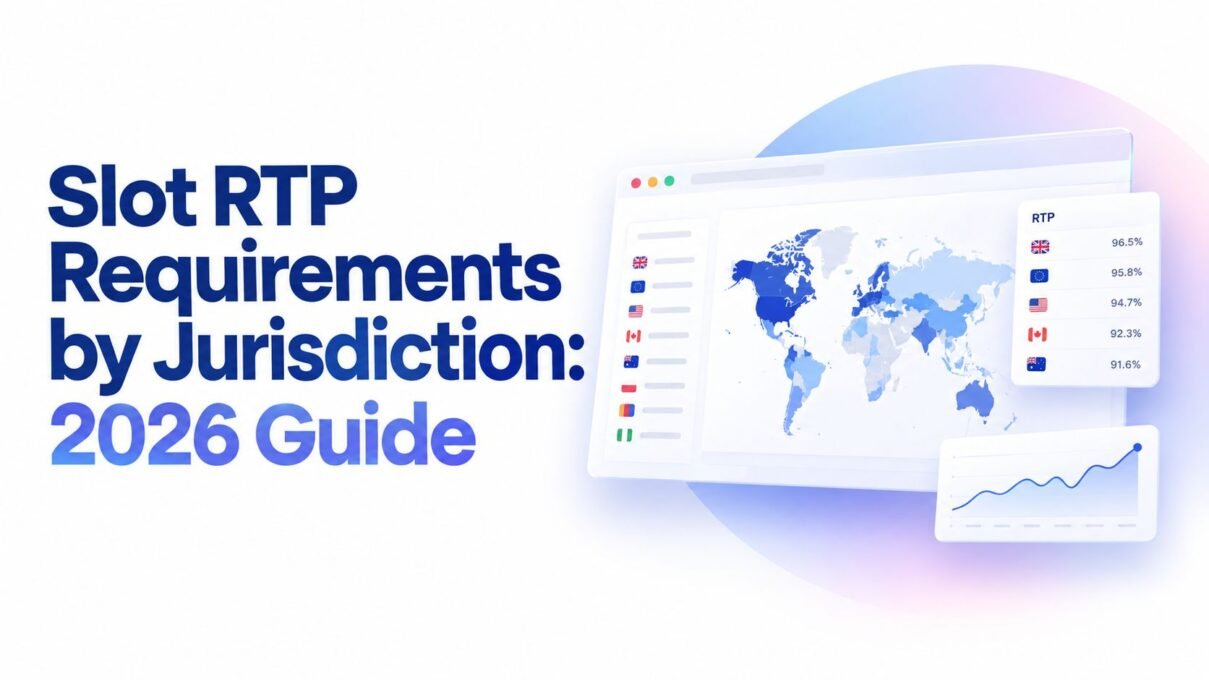
Denmark's online slot RTP floor is 93%, while New Jersey's commonly cited theoretical floor is 83%. Great Britain takes a different route, requiring accessible RTP or house-edge information without imposing a fixed minimum payout threshold.
That contrast defines slot RTP requirements by jurisdiction more accurately than any global benchmark. A game can satisfy a hard mathematical threshold in one market, require a different configuration in another, and pass a disclosure-led review elsewhere. For operators and suppliers, RTP is therefore not just a percentage in a game sheet. It is a control affecting math-model design, certification, player information, release governance, and post-launch monitoring.
The practical error is treating one approved RTP version as globally portable. A portfolio built for Denmark, New Jersey, Malta, and Great Britain needs a jurisdiction map that distinguishes what each regulator controls: the theoretical return itself, the relationship between wager levels, or the information shown before play. That distinction determines whether a launch team must redesign the game, document a configuration, or improve the player-facing interface.
Table of Contents
- Global Overview of Slot RTP Requirements
- Decoding RTP Compliance Models
- Comparing Strict Markets Versus Disclosure Regimes
- Building a Jurisdiction-Specific Compliance Workflow
- Strategic Implications for Game Providers
- Actionable Checklist for Operators and Regulators
Global Overview of Slot RTP Requirements
New Jersey's cited 83% theoretical RTP floor for slot machines sits below Malta's 85% minimum, while Great Britain uses a disclosure-led model rather than a fixed payout threshold. The numbers describe different compliance mechanisms, not a universal ranking of markets. (Industry analysis of slot house edge and RTP regulation)
A numeric floor constrains the mathematical model before deployment. Suppliers must verify that the theoretical return clears the applicable threshold. Operators must then confirm that the released version matches the tested configuration. That sequence affects game selection, cabinet or online configuration approval, laboratory certification, and margin planning. It also determines whether a lower-return variant can be offered at all.
A disclosure-led regime places the control point elsewhere. The regulator may focus on whether players can access accurate information about RTP, house edge, game rules, or winning probabilities, rather than rejecting a model below a statutory minimum. The obligation remains measurable, but testing and release controls must validate the information presented as well as the underlying game behavior.
Why one global template fails
A shared content library can make one game title appear portable across jurisdictions. Its rules, RTP label, and certification file may still require separate review. The decisive question is whether the target market treats RTP as a product-design constraint or as a disclosure attribute.
New Jersey deployment requires a model that clears the cited state floor and meets applicable wager-related constraints. Malta deployment must account for its higher cited minimum. Great Britain deployment must make relevant information accessible without relying on a prescribed numerical floor. Operators evaluating online casino games with good payouts therefore need to review the model, configuration, evidence, and player-facing disclosure together.
The operational consequence is direct: one title may serve several markets, but its mathematics, configuration record, approval evidence, and disclosures may not be interchangeable.
Slot RTP requirements by jurisdiction belong in product planning, not only in final approval. A lower-margin model may fit a disclosure-led market yet fail a strict-floor review. A model built to clear a demanding threshold may also require different commercial assumptions where regulation emphasizes transparency instead of minimum return. This divide should shape the testing matrix, certification package, and release workflow from the start.
Decoding RTP Compliance Models
RTP compliance has three separate control layers: game level, configuration level, and disclosure level. Each layer governs a different compliance object. The game layer tests the mathematical model, the configuration layer verifies which approved version is active, and the disclosure layer checks whether players receive accurate information. Treating these layers as interchangeable can send testing and certification evidence toward the wrong risk.
Game-level controls
At game level, RTP is built into the probability and payout architecture. Reviewers assess whether the approved title, as mathematically designed, produces a theoretical return that meets the target market's rule. The assessment can include the base game, bonus logic, jackpots, feature probabilities, and every other component affecting expected return.
New Jersey demonstrates why a headline RTP figure is insufficient. Slot games must provide at least 83% theoretical RTP, while variable-wager designs are subject to limits that prevent RTP from falling by more than 0.01 percentage point per wager increase or by more than 0.5% in aggregate. The testing file must therefore show how return changes across wager levels, not merely record one theoretical percentage. (Analysis of RTP requirements and wager variation)
Changes to reel probabilities, feature frequency, or payout values can create a new mathematical model even when the interface remains unchanged. The approved mathematical specification must stay linked to the exact build submitted for testing. A visual comparison alone cannot establish equivalence.
Configuration-level controls
Configuration level connects the approved title to its live deployment. A provider may maintain separate settings, feature states, or market-specific versions under one visual identity. The control question is precise: which configuration is active in each jurisdiction, and does it match the tested evidence?
This layer creates an operational risk across portfolios. A release system might expose an unapproved variant, or a commercial team might select a configuration that satisfies one market while failing another. Effective governance therefore requires version identifiers, deployment permissions, change records, and a direct link between each live configuration and its certification record.
A market-specific RTP setting is not compliant merely because another version of the same title passed review.
Disclosure-level controls
Disclosure-led regimes place the control point in the player journey. As detailed in the jurisdiction comparison below, the relevant obligation may concern the accuracy, accessibility, and timing of information rather than a prescribed numerical floor. The three-layer model still applies: the disclosed RTP or related information must describe the active game and configuration.
The 2026 slot RTP benchmark reference can support comparative review, but benchmark data does not replace jurisdiction-specific testing or approval evidence. Internal records must establish which mathematical model produced the displayed figure and whether the live build remains aligned with it.
Disclosure is therefore a control, not a cosmetic interface feature. If the screen describes one configuration while the platform serves another, the disclosure layer has failed even when the underlying mathematics is stable.
Compliance distinction: A numeric-floor jurisdiction asks whether the model clears the required threshold. A disclosure-led jurisdiction asks whether the player can access accurate information about the active model.
For suppliers seeking approval or market entry, the evidence pack must reflect this distinction. A strict-floor submission centers on mathematical thresholds, wager behavior, configuration control, and laboratory results. A disclosure-focused submission still needs reliable mathematics, then adds review of game rules, interface placement, wording, accessibility, and version alignment. Providers entering markets with accreditation processes should also map technical approval to the applicable PAGCOR game content provider accreditation requirements.
Comparing Strict Markets Versus Disclosure Regimes
The operational divide is not the percentage itself. It is the control the percentage creates. Strict numerical markets regulate the return number, while disclosure regimes regulate access to accurate information about that number. That difference determines how a supplier designs game mathematics, tests each configuration, documents approval, and controls release changes across borders.
A strict floor changes the commercial design brief before development is complete. Denmark is commonly cited as requiring a 93% statutory minimum RTP for online slots, so a supplier must select mathematics that clears the threshold and preserve that approved configuration through testing and launch. Malta is commonly cited with an 85% minimum, while New Jersey's commonly cited 83% theoretical minimum sits below both. Great Britain has no fixed online slot RTP floor, so the control emphasis shifts toward clear, accessible information about the active game model. (Country comparison of RTP requirements)
| Jurisdiction | Minimum RTP Floor | Primary Compliance Focus |
|---|---|---|
| Denmark | 93% | Statutory online slot RTP threshold, with mathematics and certification calibrated before launch |
| Malta | 85% | Numerical minimum requiring the approved model to clear the applicable floor |
| New Jersey | 83% theoretical RTP | Numerical floor, wager-related constraints, approval, and laboratory certification |
| Great Britain | No fixed statutory floor | Accessible disclosure of the game description, house edge, RTP percentage, or probability of winning |
Product selection and margin planning
The table becomes operationally useful when translated into theoretical hold. A Denmark configuration at 93% RTP implies an 7% theoretical hold, while a Malta configuration at 85% implies a 15% hold. The difference is 8 percentage points of theoretical hold, so the higher-return Denmark version produces less expected gross gaming revenue per unit of turnover, assuming equivalent wagering conditions. Maintaining the same expected GGR would therefore require turnover to rise by the ratio of the two expected returns, rather than by an arbitrary uplift.
That calculation affects portfolio decisions. A supplier cannot choose a title only because its theme, mechanics, or commercial terms fit the operator's catalogue. The paytable, feature balance, volatility profile, and approved RTP version may need to change by market. Those changes can affect player economics, promotional design, forecasting, and the evidence required for release.
Disclosure-only treatment creates a different engineering priority. The team must still define the mathematical model and confirm that the displayed RTP, house edge, or winning probability describes the configuration that is served. A screen showing one version while the platform delivers another creates a compliance failure, even if the underlying random-number process remains stable.
Compliance distinction: A numeric-floor jurisdiction asks whether the model clears the required threshold. A disclosure-led jurisdiction asks whether the player can access accurate information about the active model.
Certification and launch risk
Strict markets create a direct launch gate. If the submitted model fails the floor, deployment stops until the mathematics or configuration changes. Certification evidence must connect the theoretical RTP, paytable, feature logic, wager behavior, and build identifier.
Disclosure-led markets shift the failure mode from threshold failure to information-control failure. An inaccessible, inaccurate, or outdated game description can create regulatory exposure without any change to the mathematical engine. Providers therefore need interface review and configuration reconciliation alongside laboratory documentation.
A title may be mathematically acceptable in Great Britain yet require redesign or reconfiguration for Denmark. Certification portability must be demonstrated market by market, not inferred from the shared game title.
Regulatory monitoring follows the same logic. A feature, paytable, or configuration update can change the compliance position. Providers should track PAGCOR regulatory developments in 2026 separately from the technical record for each release. Regulatory intelligence identifies the obligation. Configuration governance demonstrates that the live product follows it.
Building a Jurisdiction-Specific Compliance Workflow
A durable workflow starts before a game enters a laboratory queue. Operators and suppliers need a controlled path from jurisdiction mapping to post-release verification, with each step tied to a versioned mathematical model and an accountable owner.
1. Map the target markets
Create a jurisdiction register for every intended deployment. Record whether the market imposes a hard RTP floor, constrains variable-wager behavior, or relies primarily on accessible disclosure. The register should also identify the accepted certification route, required documentation, and the person responsible for approving a market-specific configuration.
This first step prevents a commercial promise from reaching development before the team understands the regulatory destination. It also allows a provider to decide whether one adaptable model can support several markets or whether separate variants are necessary.
2. Freeze and audit the model
Before laboratory submission, freeze the mathematical specification and connect it to the exact build. The audit should reconcile the theoretical RTP, paytable, feature logic, wager behavior, and configuration identifiers. If the market has a hard floor, the evidence must show that the selected version clears it.
For disclosure-led markets, the same audit should generate the player-facing information. The displayed value must come from the approved model, not from a manually maintained marketing field.
3. Control the release configuration
Use deployment controls that prevent an approved market from receiving the wrong version. Each RTP setting, feature state, and localization should have a traceable status, with release approval tied to the jurisdiction register.
This is particularly important for shared remote game servers and operator integrations. The platform must distinguish between an approved configuration and a merely available configuration. A version can exist in the codebase without being eligible for every market.
4. Verify after launch
Compliance shouldn't end when the laboratory report arrives. Recent industry material describes a patchwork in which Denmark is associated with a 93% online slot minimum, Sweden and the Netherlands are framed as having explicit RTP verification expectations, and Great Britain has no statutory floor but requires accessible RTP information. The same material highlights ongoing audits, per-title certification, and re-testing after modifications in regulated markets including New Jersey, Malta, and Great Britain. (Industry overview of slot math and lifecycle verification)
The operational question is whether the live game still matches the approved theoretical model. Monitoring should compare the deployed identifier, configuration, approved documentation, and relevant operational records. A discrepancy needs an investigation path, not an informal correction.
5. Re-audit every material change
A change-management policy should define which updates trigger review. Mathematical changes clearly require attention, but configuration changes and feature modifications can also affect the approved result or the player disclosure. The team should record the change, assess the market impact, obtain the necessary testing, and retain the decision trail.
Practical control: No release should move from development to production until the jurisdiction, configuration, certification status, disclosure text, and change record agree.
Providers preparing for PAGCOR B2B provider application processes can apply the same discipline: separate regulatory mapping from technical evidence, then connect both through version control and accountable approvals. That structure gives compliance teams a defensible answer when regulators ask not only what was approved, but what was live.
Strategic Implications for Game Providers
The central commercial opportunity for game providers is modular mathematics. A provider does not need an entirely separate product for every jurisdiction, but its architecture must isolate RTP settings, feature configurations, disclosures, and certification records. Each approved version should remain identifiable throughout development, release, and operation.
This structure supports different regulatory models. Strict-floor markets require a version that meets the applicable threshold and passes local testing. Disclosure-led markets require accurate, accessible player information linked to the live configuration. The title can remain recognizable across markets, while its mathematics, features, documentation, and release controls may need to differ.
Great Britain illustrates the operational effect of a disclosure-led regime. Under the UK Gambling Commission's Remote Gambling and Software Technical Standards, the main exposure is often not rejection of a numeric RTP floor, but inconsistency between the approved game, its configuration, and the information presented to players. Providers should therefore manage disclosure text as versioned product data, with ownership, approval, and release controls. A late interface edit can create a compliance issue even when the underlying mathematics is documented correctly. (UK Gambling Commission Remote Gambling and Software Technical Standards)
Design for evidence, not only output
A passing test result is only one part of a provider's compliance asset. The stronger asset is a reproducible evidence chain showing how the model was calculated, which configuration was tested, where it was deployed, and what changed afterward. This record supports operator due diligence and gives compliance teams a defensible basis for cross-border rollout decisions.
The architecture should separate:
- Mathematical parameters, so market-specific RTP versions can be identified precisely.
- Feature controls, so restricted mechanics can be disabled without obscuring the approved model.
- Disclosure content, so player-facing information matches the live configuration.
- Audit records, so release and change decisions remain reviewable.
The distinction improves commercial evaluation. Operators can assess a portfolio by jurisdictional readiness rather than accepting a generic statement that its games are “certified.” The relevant question is whether the provider can demonstrate approval for the target market and control the title throughout its lifecycle.
Treat continuous validation as a product capability
Static approval does not cover every later release. Audits, per-title certification, and re-testing after modifications create an operating requirement for repeatable validation. A feature adjustment, configuration change, or interface update may affect the approved theoretical model or the information shown to players.
Providers should connect product management with compliance review before deployment, especially where one codebase serves markets with different RTP controls. The release record should identify the jurisdiction, tested mathematics, enabled features, disclosure version, and approval status.
The strategic conclusion is direct: RTP governance can become a competitive advantage. Providers with clean variants, traceable evidence, and disciplined change management can enter new markets with less ambiguity. Providers that treat jurisdictional requirements as an afterthought face fragmented releases, repeated testing, and avoidable disputes with operators or regulators.
Actionable Checklist for Operators and Regulators
Operators and regulators should treat the following controls as a minimum operating discipline:
- Confirm the statutory floor: Verify the applicable RTP threshold or disclosure rule with local regulatory counsel.
- Match the certified model: Ensure the live configuration corresponds to the laboratory evidence.
- Protect the player disclosure: Publish accurate RTP, house edge, game description, or probability information where required.
- Re-test material changes: Review mathematics, features, configurations, and interface changes before release.
- Maintain audit trails: Store approvals, test results, version identifiers, and change decisions together.
- Monitor the live product: Investigate any gap between the approved theoretical model and the deployed game.
- Use modular testing: Build reusable evidence without assuming that one market's approval transfers automatically to another.
The strongest recommendation is to fund modular testing and local counsel before launch, not after a failed submission. Jurisdiction-aware agility costs less than rebuilding a game, repeating certification, or explaining an unapproved configuration to a regulator. Teams reviewing their current controls can use the 2026 PAGCOR B2B accreditation checklist as a practical reference point for organizing evidence and ownership.
Operators, suppliers, and compliance professionals should audit their RTP register now, identify every market using a different control model, and confirm that each live title has matching mathematics, certification, disclosure, and change records. For continuing analysis of global regulation, game providers, licensing, and iGaming market intelligence, follow Top 1 Rank at instaplayph.com.





Join thousands of gaming professionals receiving the latest iGaming news, regulatory updates, and market insights.
